Ingredients cannot be explained
by place of origin alone.
Where was it caught? Who harvested it? In what condition did it arrive?
These are the things I look at before deciding on the day's cooking.
The Sea
At Sassa we use wild fish landed that day, chiefly from Awaji and Akashi. The work is supported by Kakukura Shoten, a fish wholesaler in the Amagasaki market now in its third generation. The man who carries it on today has been a friend of mine since high school.
Every morning at half past six we speak by phone. Together we go through what has been landed, the condition of each fish, and what should come to Sassa. He does not look only at what is laid out in the market. He also buys directly from fishermen working outside the cooperative system, and from all of it he selects what is truly in the best condition.
To send only the finest fish, the rest must also be given a proper destination. According to size and condition, each fish is matched to the buyer it suits. Because that work is done properly, the best of it can come to us.
Fish is flown from Itami to Tokyo and reaches Hiroo the same day. When it arrives, we look at it again ourselves: the firmness of the flesh, the fat, the moisture, the skin, the aroma. Only after reading its condition do I decide how it will be cooked.

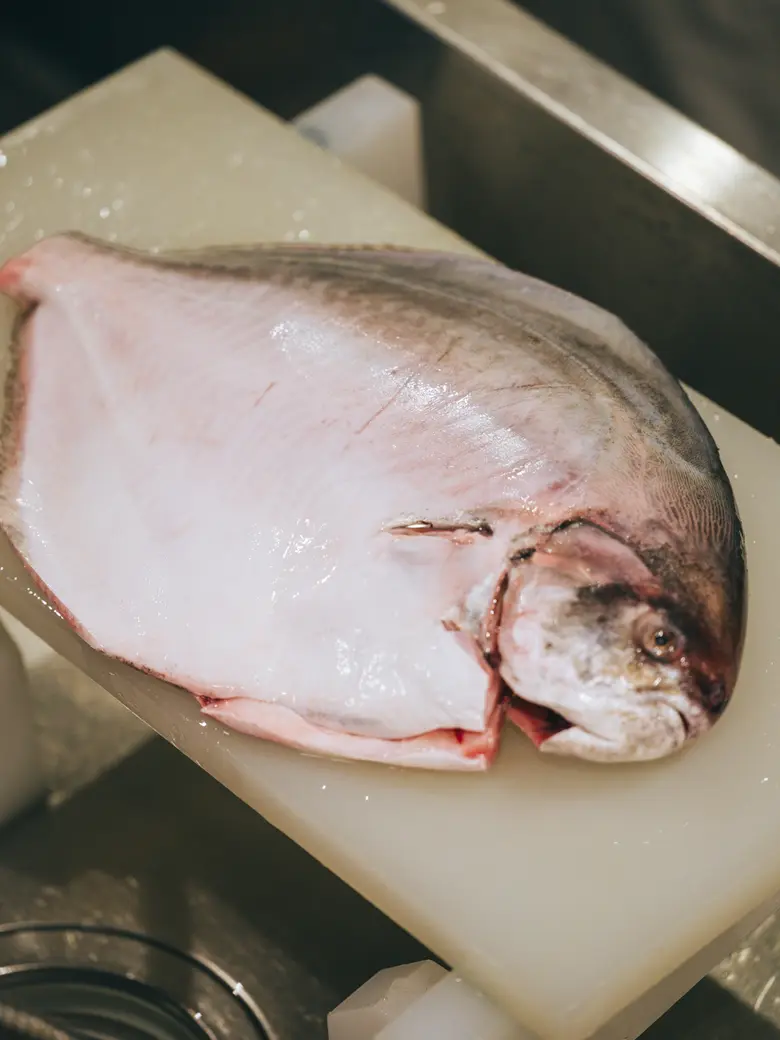
Madai (red sea bream), hamo (pike conger), octopus, abalone, red sea urchin, crab, torafugu (tiger pufferfish), shellfish. What comes from the sea changes with the season, and even the same fish is never the same two days running.
The cooking does not begin when the fish reaches the kitchen. It begins in the waters of Awaji and Akashi, at the moment the fish is landed and he first looks at it.
The Mountains
From the mountains come wild vegetables and bamboo shoots in spring, matsutake and wild mushrooms in autumn, wild birds and game in winter. Butterbur buds, tara no me, koshiabura, udo, bamboo shoots, flowering sansho. In autumn, matsutake, wild mushrooms, ginkgo nuts, chestnuts, and mukago. In winter there may be wild duck or bear. Ingredients from the water's edge, such as water shield, belong to this same seasonal flow.
Even from the same mountain, bitterness, aroma, moisture, fiber, and fat vary with where and when something was gathered. I do not force them into a dish decided in advance. I look at the condition of that day and decide from there.
Using rare ingredients is not the point. When something is genuinely good in that place and that season, I use it, and I carry it into the dish without destroying what it holds.
Rivers and Lakes
What we use from rivers and lakes is chiefly ayu, eel, soft-shelled turtle, and ajime-dojo loach.
With ayu from Gifu and elsewhere, I consider the condition of each river alongside the condition of the fish. I look at the firmness of the flesh, the fat, the aroma, and the innards. Some days the innards are used; some days they are not. I look at that day's ayu and decide.

With eel I do not fix on a single place of origin, but look for what is in good condition at the time. Soft-shelled turtle we source from across Japan, and I face it as a single ingredient — meat, fat, skin, and the dashi it yields together.

Ajime-dojo is a river fish found nowhere but Japan. It grows in clear water, and its flesh has a fineness and a distinctive depth of flavor. We have used ajime-dojo from the Wara River, and I consider it one of the most valuable things a river can give. When I can find it, I want to use it.
I do not decide the work simply because something came from a river or a lake. Where it was caught, who caught it, in what condition it arrived — I look at that, and decide the day's cooking.
The Fields
Some vegetables come directly from the growers. Others come through suppliers we trust. What matters is not making a display of how something was sourced, but choosing what is truly good in that season, on that day.
Eggplant, lotus root, turnip, daikon, beans, winter melon, cucumber, Manganji pepper, ebi-imo, lily bulb, Japanese parsley. Even the same vegetable differs from day to day in moisture, sweetness, bitterness, aroma, the tautness of its skin, the strength of its fiber.
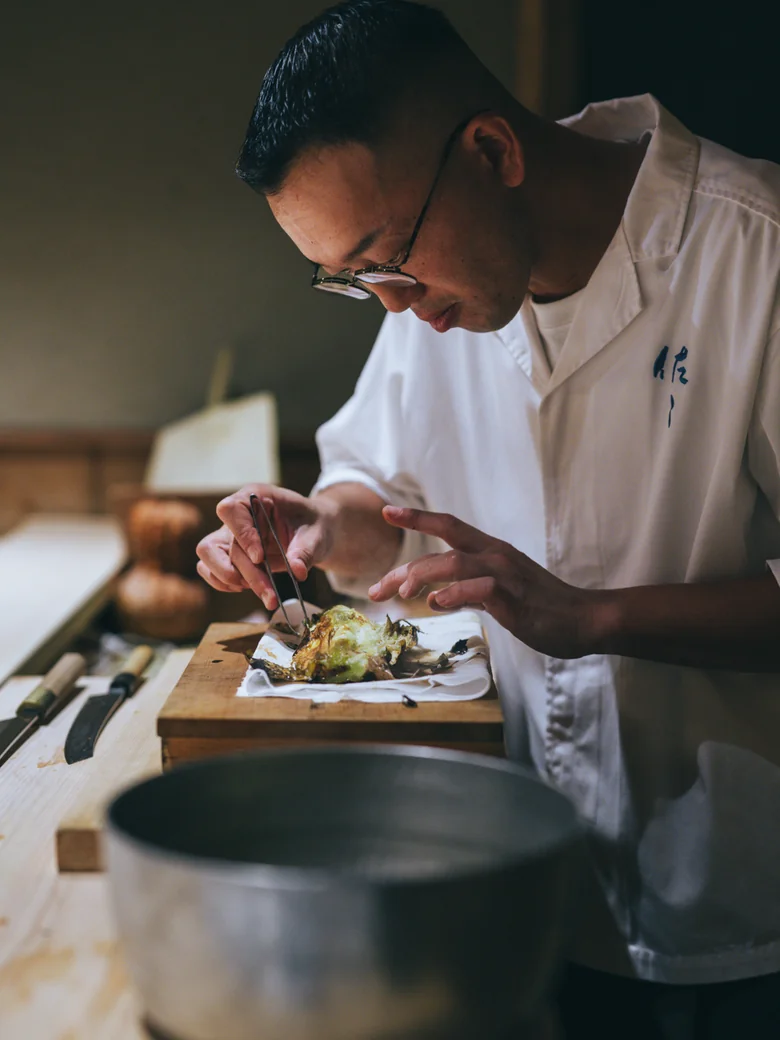
So I do not decide the dish first and fit the vegetable to it. I look at the vegetables that day and decide whether to simmer, to grill, to steam, or to fry. Vegetables are not a garnish for fish. They are cooked as ingredients in their own right.

The Rice Paddies
Rice may well be the single most important ingredient at Sassa.
Even the same variety from the same place cooks differently depending on its moisture, the time since harvest, the temperature, the humidity. I therefore adjust how I cook it each time.
Soak it, let it take up water, apply heat, let it rest. I look at that day's rice and decide how it should be cooked. What matters is not adding something to build a flavor, but drawing out the sweetness, the aroma, the stickiness, and the distinctness of grain that the rice already has.
Rice is not important because it comes at the end of the meal. How rice is cooked is work that reaches the essence of Japanese cuisine.
Wild Ma-kombu
Wild ma-kombu is indispensable to the way I think about Kinari Ryori.
In Osaka, ma-kombu has stood at the center of dashi for a very long time. Kombu carried down from Hokkaido gathered in Osaka, and from there a culinary culture built on kombu grew. Sassa's cooking stands within that current.
What I continue to use is wild ma-kombu from southern Hokkaido. Ma-kombu is not there to make umami stronger. It supports fish and vegetables from below and binds the ingredients within a bowl, while never pushing itself forward. That way of being sits very close to the idea of Kinari Ryori.
Kombu Doi has visited the shores of southern Hokkaido for many years, building relationships with the producers and handling wild ma-kombu throughout. Over the long time I have used it, trust has grown between Mr. Doi and me.
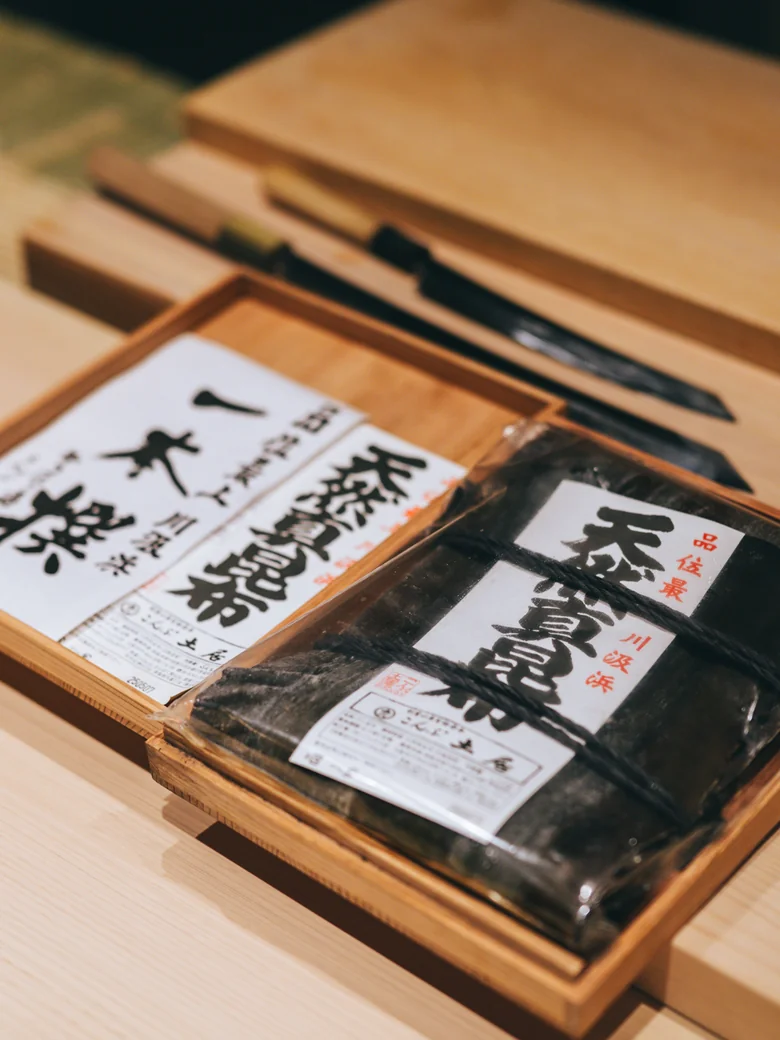
Light in flavor, and in that lightness, true pleasure.
Light does not mean weak. It means laying nothing unnecessary on top, and bringing a dish to the point where the ingredient's own character can be seen. Rather than adding flavor, bring out what is already there. Wild ma-kombu is one of the things that holds this idea up.
For Sassa, then, wild ma-kombu is not simply material for dashi. It is the foundation of the cooking, and the ingredient at the root of Kinari Ryori.
Honkarebushi
We use honkarebushi made from line-caught skipjack. Only as much as is needed is shaved, on Mr. Yamakita's shaver, in the moment before the dashi is drawn — because I want the aroma of that first moment to go into the dashi itself.
Honkarebushi is not there to make umami stronger. It gives aroma and definition to a dashi made of wild ma-kombu and water. A small change in the shaving, the thickness, or the temperature changes how that aroma emerges, so I adjust it to the day's dashi and the day's cooking.
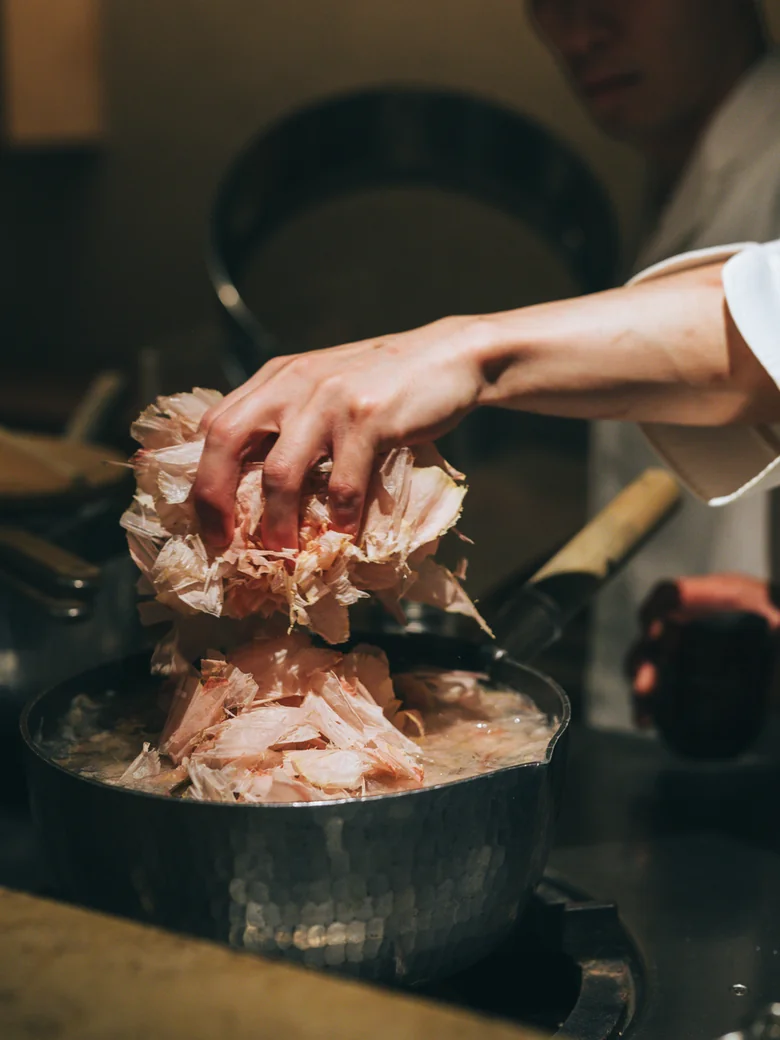
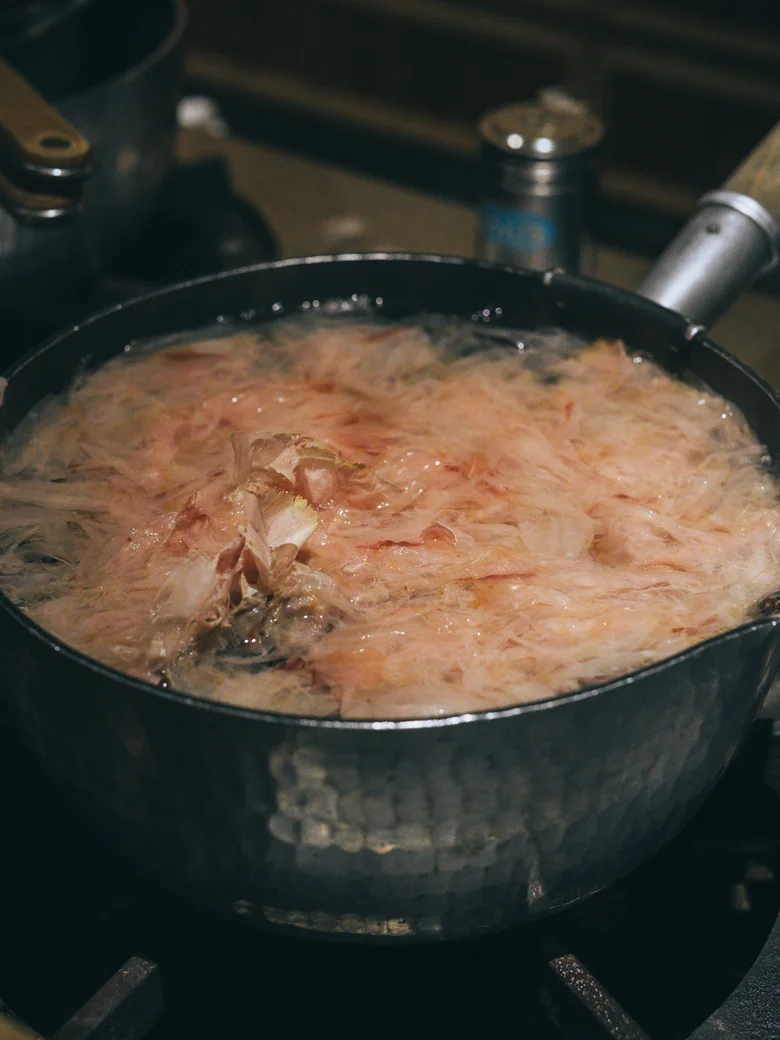
The kombu builds the foundation; the honkarebushi lays aroma over it. But the honkarebushi itself has no need to come forward. It supports the ingredient's own character and leaves only the definition the dashi requires. That is why it is shaved at the last moment.
Water
We use Sakuragawa, renowned water from Nose in Osaka, long used as brewing water for sake.
Water is not only for dashi. It soaks the rice, touches the fish and the vegetables, and does the work of simmering and steaming. Because it is present in nearly everything, the choice of water belongs to the foundation of flavor.
The point is not to make the water itself noticeable. It is to interfere with nothing — not how ma-kombu releases its flavor, not the aroma of the honkarebushi, not the finish of the rice, not the taste of a simmered dish — and to support the character of the ingredient. Water is hard to see, yet it builds the ground the cooking stands on.
Fire
A single difference in how heat is applied changes an ingredient's expression entirely. For grilling I use binchotan, watching the state of the charcoal and the distance from the fire, and applying heat to suit the day's ingredient.

For simmering and for dashi, the thinking changes. Bring it fully to the boil, or hold it quietly below? Cook it hard, or keep the temperature gentle? The difference changes how the dashi comes out and how the ingredient's flavor emerges.
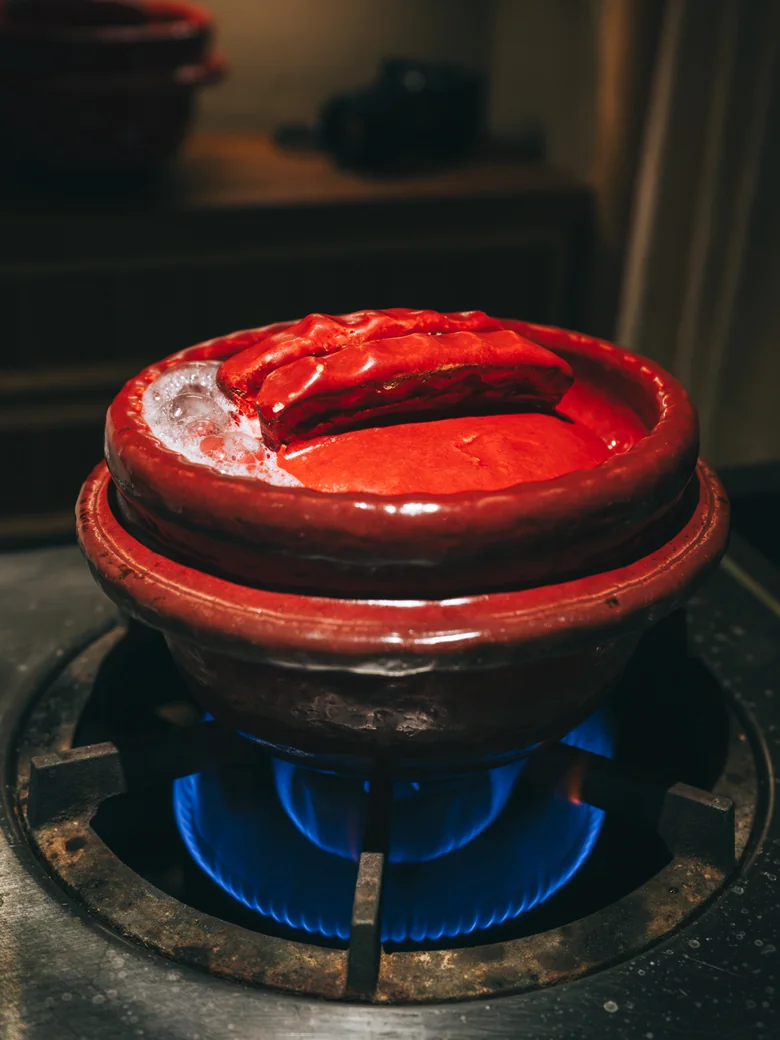
Fish, vegetables, rice, dashi — each has a fire that suits it. Rather than fitting the ingredient to a fixed method, I look at the ingredient and the dish and decide the fire. Strong is not better, nor is gentle. I choose the fire needed to bring out that day's character in that day's ingredient.